I’ve started to get “into” Twitter, the micro-blogging site, in the last month or so. One trend that I picked up on is that of “hashtags” where you put a hash (pound) symbol followed by a word somewhere in your message. This makes is searchable. The most recent that I’ve participated in is #firstmac, for which my contribution was:
Tag: Apple
- Yummy Version 1.0.3 – New minor release of Yummy, my Delicious.com client for iPhone. Fix for something that took me two weeks to track down, an annoying edge condition I found when editing bookmarks under certain conditions and a problem that Apple rejected the original binary for.
- Apple Introduces Revolutionary New Laptop With No Keyboard – Sounds almost plausible…
- Travel time to major cities: A global map of Accessibility – Fascinating.
What do Britney Spears and Yummy, my iPhone Delicious.com client, have in common? If you had asked me a few months ago I would have said nothing but I’d have been wrong. No, they both have had to grow up in public.
For a version 1.0 product, Yummy seemed solid to me. It was fast, coped will all my bookmarks and had the ability to add, edit and delete entries. I didn’t think that this would remain as a unique feature for as long as it has, but hey, that’s a bonus.
My iPhone application, Yummy, has been on sale in iTunes for a couple of months now and, as a number of other developers have noted, after the initial launch sales figures take a significant nose dive very quickly. I’ve been trying to think of ways to increase visibility without taking too much time away from actually making enhancements to the software.
As luck would have it, I got a “free trial” of Google AdWords and thought I would give that a try. Results have been… well, not exactly what I was expecting.
It’s been over five years since I last told you about my favourite computer and programming related books (don’t believe the date on that article. It’s been edited lightly a couple of times since I first posted it).
Having said that, some things have not changed. The vast majority of books on the shelves of your local retailer are very specific. Publishers seem to eschew broad, generally useful texts in preference for yet another beginners guide to Microsoft Word or C++ (or, more likely, Visual C++ 2005 Special Easter Edition SP2). I do not understand this. Sure, there’s a genuine need for “how to” books for specific technologies but is it not more useful to learn how to solve problems in general rather than how to solve a particular problem with a particular product?
When they first announced the App Store and the iPhone SDK I thought that a blogging tool might be something worth downloading. On the first day TypePad had their application but we had to wait until this week for the WordPress equivalent. On the plus side, WordPress for iPhone is both free and Open Source.
First impressions: it’s nice. Setting up a new blog is simple. Writing a new post is straightforward too, just press the “new” button, fill in the fields much as you would in the web interface and get typing. You can also add photos — either directly from the camera or from your photo library — but only to the end of your post.
Earlier today daringfireball pointed me to Byline by Phantom Fish, a Google Reader client-side application for the iPhone.
Since I recently abandoned Safari’s built-in RSS reader for Google, this is just the kind of application that I have been looking for. Unlike a lot of programs I’ve found on the AppStore, Byline seems to be very well put together. The author appears to have included a thoughtful set of features. Not everything, just those elements you use every day; either a good starting point for later versions or an Apple-like approach depending on your perspective.
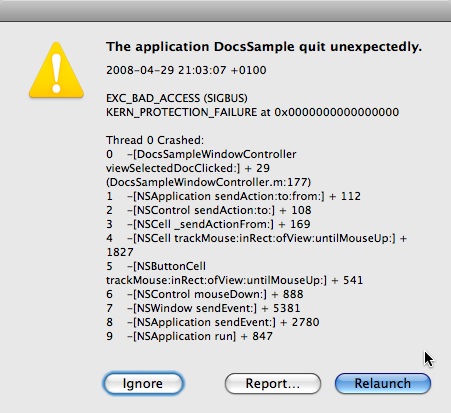
A common refrain is that computers are too complicated for ordinary people to use. Yet mostly when I see people sat with a notebook on their lap I don’t see frustration. The confusion tends to come when something doesn’t work as expected. Naturally bad design plays a big part in this but the biggest stumbling block comes when a dialog box like this pops up:
There’s this feeling in the Mac community that you should avoid the first iteration of any new Apple product. Yet back at the beginning of this decade I went out and foolishly put £350 down on a first generation iPod. Sure, it looks clunky now. It’s bigger and lower capacity than the current revisions, has a monochrome screen and the scroll-wheel actually rotates. But for a version one product it was remarkably well rounded.
- Everything you ever wanted to know about “Rickrolling”… – The man who sang “Never gonna give you up,” the classic Stock-Aitken-Waterman pop song, makes an unexpected come back. (What’s wrong with Debbie Gibson by the way?!)
- Lies and Statistics – Most people in Britain believe that Jesus rose from the dead. Or do they…?
- Our Bad. Wired Had Some Tips For Apple — We Were Wrong. – Fascinating to see how much things have changed in the last ten years.